
FACULTY OF SCIENCE AND TECHNOLOGY
The Faculty of Science and Technology (FST) is a basic academic structural unit of the University of Latvia, established for the organisation of academic activities in the following fields of science:
- computer science and informatics;
- electrical engineering, electronics, information and communication technologies;
- physics and astronomy;
- mechanical engineering and mechanics;
- mathematics;
- materials science;
- nanotechnology;
- social and economic geography;
- earth sciences, physical geography and environmental sciences;
and interdisciplinary fields related to:
- school and university didactics in STEM fields;
- optometry and vision science;
- radiation chemistry;
- quantum technologies;
- perceptual and cognitive research;
- and other interdisciplinary topics according to the Faculty's competence
The structure of the Faculty consists of the Faculty of Computing, the Faculty of Physics, Mathematics, and Optometry, the Faculty of Geography and Earth Sciences, the Institute of Geodesy and Geoinformatics, the Institute of Chemical Physics, the Institute of Astronomy, the Institute of Atomic Physics and Spectroscopy, the Institute for Mechanics of Materials, the Institute of Physics, the Interdisciplinary Centre for Educational Innovation, as well as The Natural Resource Research Centre.
The Faculty of Science and Technology strives for excellence in education and research, promoting innovation and interdisciplinary collaboration. The primary goal of FST is sustainable development and improvement of well-being of the society, preparing students to adapt to a changing environment and make significant discoveries in their fields.
The faculty offers a wide and diverse range of study programmes, including computer science, physics, mathematics, optometry, geography, geology, and environmental science. Students receive excellent academic education and practical skills necessary for a successful career in today's technology and science sectors.
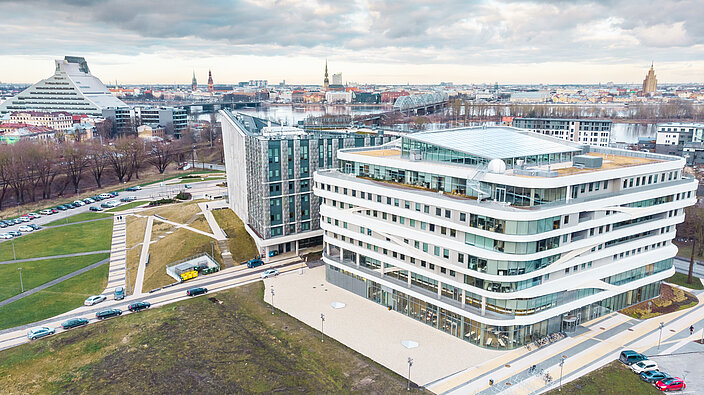
Studies of FST take place at:
- Jelgavas iela 1 - study programmes in geography, geology, environmental science, and optometry;
- Jelgavas iela 3 - study programmes in physics and mathematics;
- Raiņa bulvāris 19 - study programmes in computer science.
Fakultātes struktūru veido Datorzinātņu nodaļa, Fizikas nodaļa, Ģeogrāfijas nodaļa, Ģeoloģijas nodaļa, Matemātikas nodaļa, Optometrijas un redzes zinātnes nodaļa, Vides zinātnes nodaļa, Astronomijas institūts, Atomfizikas un spektroskopijas institūts, Fizikas institūts, Ģeodēzijas un ģeoinformātikas institūts, Ķīmiskās fizikas institūts, Lāzeru centrs, Materiālu mehānikas institūts, Skaitliskās modelēšanas institūts, Starpnozaru izglītības inovāciju centrs, Studiju servisa centrs, un Dabas resursu izpētes centrs.
LU EZTF tiecas pēc izcilības docēšanā, zinātnē, sadarbībā ar industriju. Piesaistot talantīgus mācībspēkus – jau sevi pierādījušus pētniekus un jaunus, perspektīvus zinātniekus – tiek radīta auglīga vide talantu attīstībai. Nozīmīgu vietu LU EZTF darbībā ieņem zinātne. Fakultātē darbojas vairākas pētniecības struktūrvienības, kas veic ne tikai Latvijā, bet arī starptautiski atzītus pētījumus. Studiju procesa sasaiste ar zinātni un industriju dod iespēju jau studiju laikā ieraudzīt apgūtā praktisko pielietoju darba tirgū.