

BALTEHUMS IV: WORLDS IN RELATION
Fourth Baltic Conference on the Environmental Humanities and Social Sciences
1-3 December 2026, Riga, Latvia
Call introduction
In a time of planetary recomposition – ecologically, climatically, politically – the relations between humans, nonhumans, landscapes, and knowledge systems are being reshuffled, unsettling what coexistence means and what it might yet become. Situated on the northern margins of Europe, where sea meets land, saltwater meets freshwater, and darkness gives way to midsummer light, the Baltic Sea region is a landscape of transitions. It is precisely this in-between quality that makes it a sensitive register of planetary change: what is being unsettled here speaks to broader questions of how humans and more-than-human worlds compose and recompose their lives together.
This is also a region of deep ecological time – its forests, bogs, and lakes are a direct legacy of glacial retreat, its four seasons are a structuring force that has shaped livelihoods, food cultures, and ways of knowing across centuries. Taking a long view means attending to these cycles of freezing and thawing, growth and harvest, alongside the more recent ruptures of industrialisation, water infrastructures, forest and agricultural land management, urbanisation, and shifting land-use practices. Climate change and biodiversity loss now layer onto these longer rhythms, continuing to unsettle familiar relations between humans and the more-than-human worlds.
The 4th BALTEHUMS conference invites reflection on how these worlds in relation take shape and endure. Rather than assuming a single path through environmental change, we are interested in the diversity of ways people dwell in, make sense of, and sustain relations with water, soil, air, and more-than-human life – across seasons, generations, and the long durations of ecological and cultural history. What worlds are brought into being through particular practices, imaginaries, and interventions? What forms of knowledge, care, and coexistence persist, and which are lost or transformed?
We invite you to join us in Riga at the beginning of winter – a Baltic capital city shaped by river, sea, and the long arc of northern seasons – to share work on how these changing worlds are narrated, negotiated and tended.

We welcome contributions across diverse lenses, including but not limited to:
- environmental histories, memories, and imaginaries;
- seasonal rhythms, winter histories, and long-term cycles of nature and society;
- water cultures, practices, and hydrosocial perspectives;
- climate change, environmental loss, and more-than-human vulnerabilities;
- human-animal relations and multispecies commons;
- everyday environmental practices, experiences, and ways of ecological knowing;
- energy humanities;
- infrastructures, technologies, and interventions in land and water;
- environmental philosophy, ethics of care, and multispecies solidarity;
- poetic, artistic and sensory engagements with the environment, including film, theatre, and performance;
- literary and folkloric representations of more-than-human worlds;
- interdisciplinary and transdisciplinary approaches to environment;
- cross-border collaborations across the Baltic Sea region.
The conference brings together scholars across environmental humanities, social sciences, and related fields, as well as artists and practitioners to spend a few winter days in Riga with the Baltic Sea region as both context and question – a place where the stakes of living with water and land, and more-than-human life are felt with particular acuity.
Registration details have been sent by email to all accepted participants. We kindly ask participants to complete their registration by 15 September 2026.
The call for abstracts is now closed.
We welcome contributions in both recognised academic (presentations, posters, roundtables) and alternative (audio-visual and other) formats, as well as ideas for networking events. Pre‑constituted sessions (4-5 papers) are welcome. Each presenter should submit an individual abstract via the main form and indicate the shared session title.
Submissions including a 300-word abstract and author data for all contributions should be submitted through the digital platform by 15 June 2026.
CLICK HERE to submit an individual paper, poster, or artistic intervention (including contributions that are part of a pre‑constituted paper session).
CLICK HERE to submit a roundtable, discussion, or artistic group session proposal.
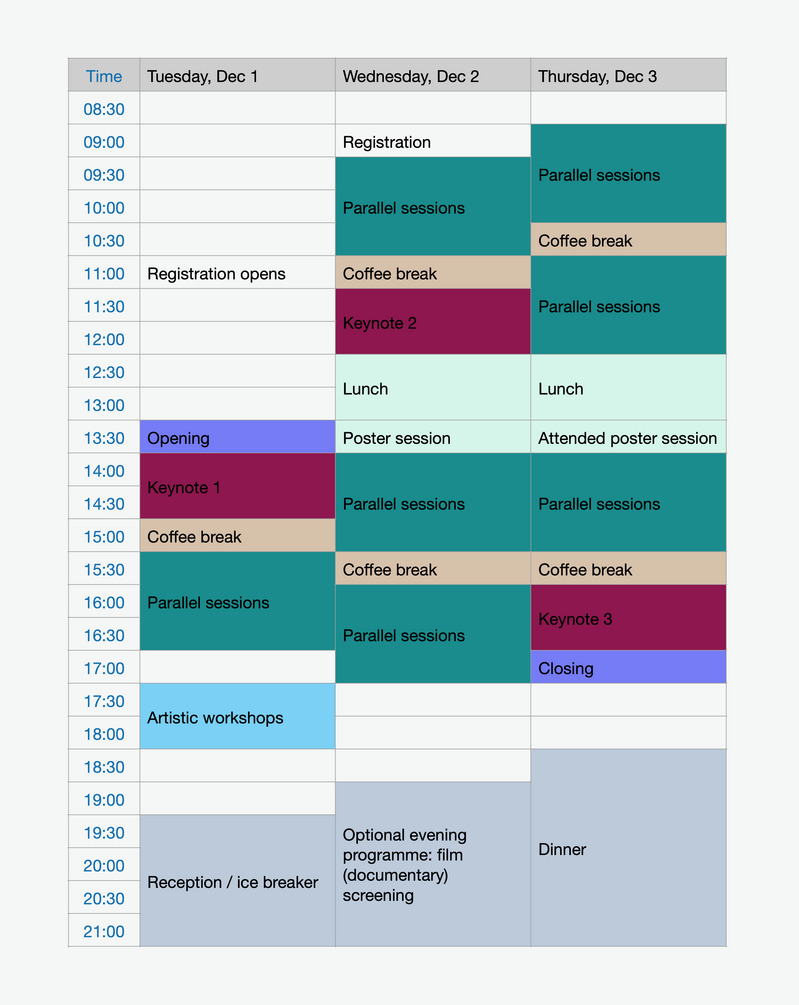
The conference includes three plenary sessions:
Tuesday
· Opening session: welcoming words
· Keynote 1: Simo Laakkonen, Senior Research Fellow, Landscape Studies (University of Turku), Adjunct Professor of Social and Economic History (University of Helsinki) (https://www.utu.fi/en/people/simo-laakkonen)
Wednesday
· Keynote 2: Astrida Neimanis, Professor of English and Cultural Studies and Canada Research Chair in Feminist Environmental Humanities, University of British Columbia Okanagan (https://ccgs.ok.ubc.ca/about/contact/astrida-neimanis/)
Thursday
· Keynote 3: Miķelis Grīviņš, Research Professor at Rīga Stradiņš University (Healthy and sustainable food systems group) and Senior Researcher at the Baltic Studies Centre (https://www.rsu.lv/en/mikelis-grivins)
· Closing session: reflections and next steps for BALTEHUMS?
The conference will be held on-site at the University of Latvia House of Nature.
Address: Jelgavas iela 1, Riga, LV-1004, Latvia.
There are several accommodation options available in Riga for BALTEHUMS IV participants.
Hotels on the left bank of the Daugava are particularly convenient for the conference venue, with several options located within approximately 15-25 minutes’ walking distance of the University of Latvia House of Nature.
Participants may also choose to stay on the right bank of the Daugava, particularly in Old Riga and the city centre, where there is a wider selection of hotels. From there, the conference venue can be easily reached by public transport or taxi.
Special offer for BALTEHUMS IV participants
BALTEHUMS IV participants can receive a 15% discount at Bellevue Park Hotel Riga when booking directly through the hotel website and using the code BALTEHUMS.
The hotel is located on the left bank of the Daugava, next to Uzvaras Park, and is conveniently situated for reaching the conference venue.
For any further inquiries, please contact baltehums2026@gmail.com
Download the call as a PDF from HERE
Programme committee
Anda Ādamsone-Fiskoviča – Baltic Studies Centre, Latvia
Simo Laakkonen – University of Turku, Finland
Kati Lindström – KTH Royal Institute of Technology, Sweden
Ulrike Plath – Tallinn University, Estonia
Małgorzata Praczyk – Adam Mickiewicz University, Poland
Artis Svece – University of Latvia, Latvia
Bethany Wiggin – University of Pennsylvania, United States
Anita Zariņa – University of Latvia, Latvia
Local organising committee
Anda Ādamsone-Fiskoviča – Baltic Studies Centre
Ieva Astahovska – Latvian Centre for Contemporary Art
Karīna Ješkina – University of Latvia, Department of Geography
Anne Sauka – University of Latvia, Department of Philosophy
Artis Svece – University of Latvia, Department of Philosophy
Anita Zariņa – University of Latvia, Department of Geography