
What has your professional journey been like leading up to becoming Vice Dean for Science?
Quite a varied one. I have tried my hand at different fields, and throughout my professional journey I have always been guided not only by an interest in the subject itself, but also by the people who inspire me and whom I want to follow. That is how I once ended up working with Professor Jānis Spīgulis. I was very captivated by his lectures, and I began working in the field of optical fibers. I also defended my bachelor’s thesis on this topic.
Later, I felt that a change was necessary, so I joined Professor Ruvin Ferber’s group. He was one of those people whose enthusiasm and ability to talk about his field genuinely drew me in. That is how I turned to the spectroscopy of diatomic molecules, and my master’s thesis was developed in this field. After that, life itself presented the next directions — I had the opportunity to work in atomic gas magnetometry, and I defended my doctoral dissertation in that field.
Then I was offered the chance to try magnetic field microscopy using nitrogen-vacancy centers in diamond. Although I was somewhat skeptical at first, I gave it a try, and this field turned out to be very exciting. This choice took me to the United States for the first time. At the University of California, Berkeley, I learned a great deal in just a few weeks while working with an excellent team. Later, I chose to develop a postdoctoral project in collaboration with Linköping University in Sweden, and step by step my career grew — I became a leading researcher at the University of Latvia, and later also an assistant professor of research at the University of New Mexico in the United States.
How I ended up in this particular position is still not entirely clear to me. I had only just returned from the United States and did not yet have a clear plan of action. Then I was told that such a position had been announced and that I should apply. At first, I did not believe I was suited for such a role, but at the same time I did have the desire to tackle the problems I had encountered as a scientist. In general, I should say that my professional path has never been very rigidly planned — rather, I have tried to make use of the opportunities that life offers. If I see an interesting opportunity, I am willing to give it a try.
You spent quite a long time outside Latvia. What was the decisive moment or motivation that made you return home?
I spent about three and a half years abroad. At first, it seemed that life in the United States might develop into something long-term. The nature there is fantastic, and every weekend feels like a little vacation — my family and I even considered applying for a green card and settling in the U.S. permanently.
However, after the change in political power, I increasingly felt that the political and social environment was becoming different. The more complicated and, in my view, less democratic sides of the system became especially visible. In the public sphere, messages were increasingly being voiced that immigrants were not really welcome, and attitudes toward Europe also became more negative.
I realized one thing: if society is being polarized and people are being forced to choose sides, then I am not American — I belong to Europe and Latvia. If I am not needed there, then I can invest my knowledge and abilities elsewhere.
How do you like to spend your free time when you manage to break away from work?
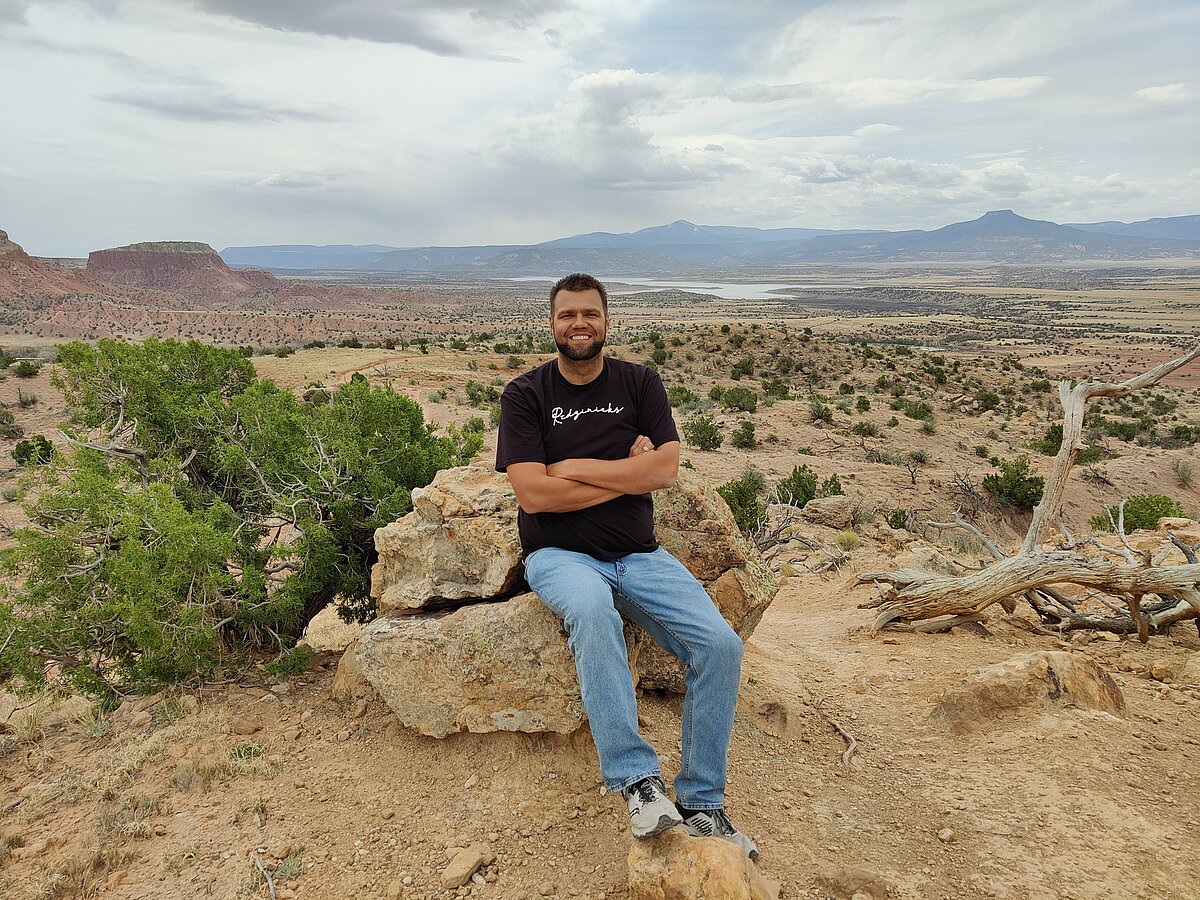
If we are talking about my time in New Mexico, I spent a great deal of time hiking in the mountains. Over the course of three and a half years, my family and I completed about 200 trails and covered more than 800 kilometers on mountain routes in total. That is still something I would love to return to. A part of my heart has certainly remained in the wild nature of the American Southwest.
In everyday life, I also find joy in very simple things — I like cooking, and I enjoy spending time with a small circle of friends. I also gladly play both board games and computer games.
What helps you find inspiration and maintain motivation in everyday life, both in academic work and in administrative duties?
I am an optimist — sometimes even a stubborn and headstrong optimist — and I believe that things will turn out well. What helps me is breaking large projects down into smaller stages: what needs to be done today, this week, this month. That helps me move forward and prevents the sheer volume of tasks from overwhelming me. Big things are accomplished step by step.
What are your first impressions in this position, and how is your vision for the future taking shape?
The challenges are significant. At the moment, I can see that the "backbone" of the university’s and the faculty’s management is ready for positive change. However, classical universities are always institutions with considerable inertia. We will see how successfully we can steer this “train” onto slightly different tracks.
But again, as an optimist, I believe it is possible. If I thought otherwise, I would not be here.
