
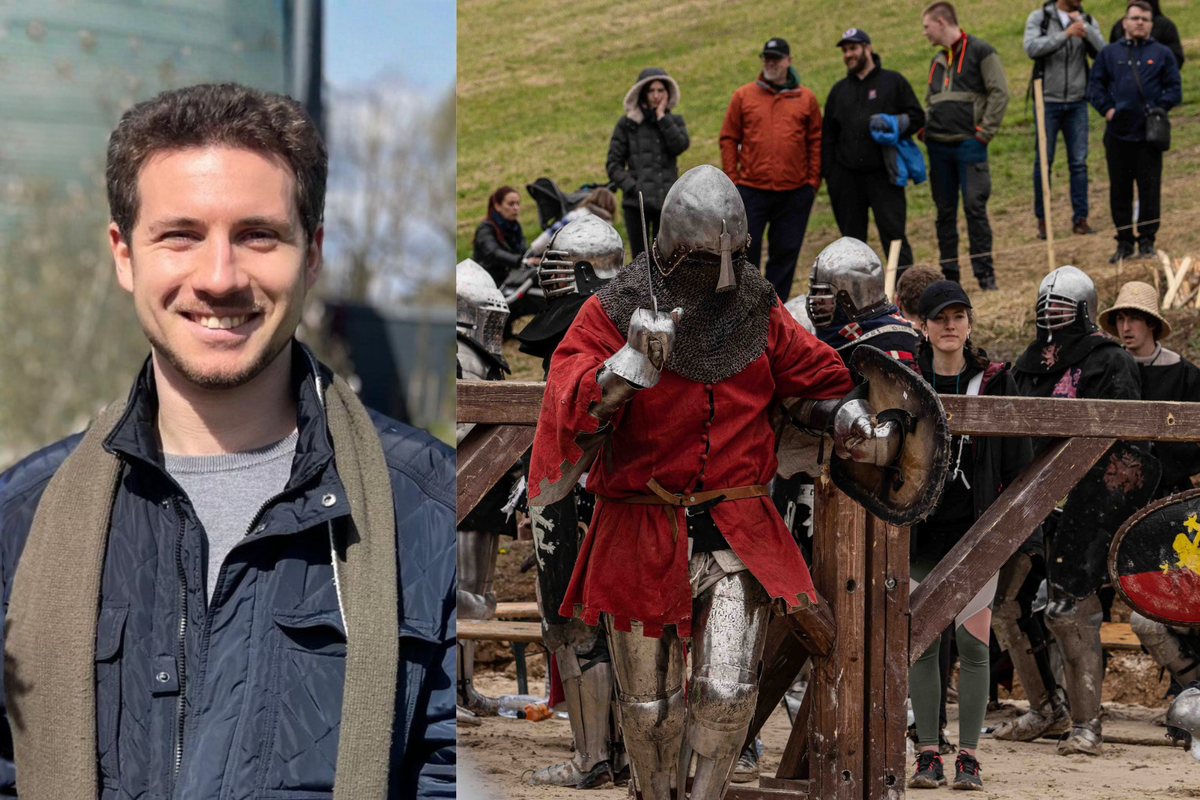
Institute of Numerical Modelling (INM) Lead Researcher Mihails Birjukovs works at the intersection of theoretical physics, numerical modelling, and data analysis — with a career shaped by curiosity, independence, and a very hands-on approach to science.
In this interview, he shares his journey from student researcher to leading his own direction, his motivation, and how he helped shape a more open seminar culture at INM.
How long have you been working at INM, and what has your professional path been like so far?
I have been associated with INM for about eight years - I started working there already in the second semester of my master’s studies. Before that, during my bachelor’s studies, I worked at the Laser Centre, because I knew I could pursue both theoretical physics and mathematics, but I wanted to try doing experiments as well.
In the first semester of my master’s, I started looking for a job and heard that INM offered a wide range of projects - some involving numerical modelling, others requiring not only theoretical work but also experimental work.
I was very fortunate with my supervisor - Lead researcher Andris Jakovičs taught me a lot, not only about the scientific side of the work but also about management. He gave me a great deal of freedom, and we worked together throughout both my master’s and doctoral studies.
“After my third week, he jokingly said that everything about me was already clear, and that the best approach was simply not to interfere with my work.”
Later, I decided to take a short break from my doctoral topic and offered my skills to the Laboratory of Magnetic Soft Materials (MMML) at the Department of Physics. I told them: “If you have problems related to image and data analysis, I can solve them using methods I developed during my PhD.” Within two weeks, I had started working there.
Interestingly, all the methods and approaches I had developed with students during my doctoral studies turned out to be very useful and were successfully applied in this laboratory.
After two years, I realized I no longer wanted to work under someone else’s supervision. I already had enough of my own ideas, had supervised students, and understood the academic environment and its system quite well. So I began thinking about establishing my own research group. Otherwise, I felt I wouldn’t want to stay in science.
“Having your own group and projects allows much greater freedom - you can choose projects, attract funding, and build a team based on your own principles.”
In other words, you gain much more control over your professional direction.
How do you usually spend your free time outside of work?
I spend quite a lot of my free time working as a freelancer, using the skills I have developed in programming, mathematical physics, and image and data analysis. These skills are currently in high demand.
In the past, I really enjoyed playing volleyball. Later, I switched to something completely different - fencing. After that, I moved on to medieval combat, where I wore 30–50 kg armour and used steel weapons. I even participated in world championships, both individually and in teams, as well as in European-level competitions. In Latvia, we have a club called “Livland,” where I also trained.
That was my first serious experience in combat sports, and I really enjoyed it. However, over time I met my current coach from the Latvian MMA Federation and realized that I was more interested in fighting without armour-specifically close combat. It offers much greater variety and challenges both the body and the mind more than fighting in armour.
“Combat sports are a kind of science themselves, and they also help in my work.”
If I can endure these training sessions, I can also handle intense periods such as writing project proposals.
When I have more free time, I really enjoy cooking - I try to recreate dishes I’ve tasted in restaurants at home.
How did the idea of organizing weekly INM seminars come about?
So far, 19 weekly seminars have already taken place. In the past, similar seminars were organized at INM, but at that time colleagues lacked the capacity to maintain regularity, and the seminars eventually faded out.
While working at MMML, I saw that colleagues gathered once a week to share their results. I also started participating and presenting my progress. I really liked that MMML seminars were held regularly, but they were mostly local.
When I returned to INM and started building my own research group and project team, I thought that I could also organize seminars—but with a slightly broader approach. That’s how it started.
Initially, I wanted to focus on a local audience - mainly institute researchers and people from FST. Gradually, however, we began thinking more broadly and have now successfully attracted international researchers as well.
Could you briefly describe these seminars for colleagues who have not yet attended?
The seminars do not have to be strictly related to INM research areas. We invite people engaged in research or working in industry, whose topics are related to mathematics, physics, computer science, or similar fields.
I also plan to invite students to present their research, for example within the framework of their thesis work. I want to promote an open exchange of ideas, where anyone can share their experience and research.
The seminar format is about an hour and a half - roughly one hour for the presentation and another half hour for questions and discussion. These seminars are more like informal meetings where ideas can be shared freely. Participation is possible both in person and remotely.
What motivates you to be so active and involved in various activities?
I really enjoy what I do, and I understand why I do it. I have chosen a field that keeps my mind active, and that gives me extra energy. That’s why I rarely feel completely exhausted in the evening.
It also helps a lot to be surrounded by people with similar enthusiasm - it inspires and motivates me.
“If you feel generally happy in life, you naturally have more energy.”
Discipline is important, as well as the ability to organize your time, and it’s essential to remember to rest by doing something you truly enjoy.
Then work no longer feels like an obligation. In fact, I more often have to force myself to stop and take a break, rather than to keep working.
Mihails’ journey at INM reflects a research path shaped by independence, experimentation, and a strong sense of ownership over his work — from early academic exploration to building research structures and communities of his own.
What stands out most is not just the scientific depth of his work, but the mindset behind it: freedom, curiosity, and the belief that research should be something you actively shape, not just follow.
 Lead Researcher Mihails Birjukovs.)