
What has your educational and professional journey been like?
I completed my primary and secondary education at Edgars Kauliņš Lielvārde Secondary School. I earned my Bachelor’s, Master’s and Doctoral degrees at the Faculty of Computing of the University of Latvia. I also started working in the fascinating field of programming very early on - on my third day of studies, in fact - and it almost derailed my studies. It taught me a lesson that I also share with students and children: it is very difficult to return to your studies once you have left them, and you will never have more free time than you have today.
I certainly cannot complain about my professional experience or the opportunities for growth it has brought. The first major chapter of my professional career was from 1997 to 2005, when I worked on the Latvian Education Informatization System (LIIS) project implemented by the University of Latvia. We created a nationwide distributed information system in which data from three nationally significant registers was replicated semi-automatically - using dial-up connections and even “floppy-net” segments - from schools to regional centres and from there to central servers at the University of Latvia and the Ministry of Education and Science. These systems, in turn, supported extensive analytics, quality control and reporting. As the project used Lotus Domino software, I obtained the CLP (C Certified Professional Programmer) certification and the highest-level CLI (C Certified Expert Programmer) certification.
In 2000, I joined the newly established Cisco Networking Academy, a global IT and cybersecurity education programme created by Cisco to provide learners with both practical and theoretical knowledge in the field of technology. I became one of the first two Cisco-certified instructors in Latvia. I also trained instructors from other higher education institutions. This marked the beginning of my career in teaching. At first, I taught teachers and specialists from regional centres, and later I also began teaching students at the University of Latvia. And here I am today. In 2006, I obtained a MikroTik instructor certification and introduced one of the MikroTik courses as an elective for students. MikroTik (officially SIA “Mikrotīkls”) is a Latvian company founded in 1996 that manufactures computer networking hardware and develops software.
The second major chapter was connected with the Institute of Mathematics and Computer Science of the University of Latvia (LU MII), where I worked on several interesting projects between 2006 and 2022, including LatvianGrid and BalticGrid, as well as the first cloud computing project, E-spiets, in 2008, followed by E-spiets2 in 2015. I then led the group responsible for connecting the Latvian Academic Network (LAT) with the European academic network GÉANT. We also piloted the first QKD (Quantum Key Distribution) link and, in 2021, in cooperation with LVRTC, developed a full-solution prototype for a quantum-secure encrypted channel using real LVRTC infrastructure.
The third major chapter has been the LatQN project, which ran from 2023 to 2025. During this period, I joined The Latvian State Radio and Television Centre (LVRTC) as a Lead QKD Engineer. We built the first quantum communications infrastructure in the Baltic States, while also carrying out several new developments and research activities aimed at its further advancement.
What are your main responsibilities and the projects you work on in your daily life?
My everyday work has been connected with teaching at the University of Latvia for 25 years now. I am currently an Associate Professor in the Department of Computing at the University of Latvia’s Faculty of Science and Technology. I teach seven courses, and together with students, we explore promising ideas through their final projects. And since this summer, I have embarked on a new chapter - the Centre for Quantum Excellence and Competence of Latvia (LKIKC).
The opening of the Centre for Quantum Excellence and Competence has just taken place. Could you give our colleagues an overview of what the Centre will focus on?
The Centre has been established as a structural unit of the UL FST, but its ambition is to support Latvia’s entire quantum ecosystem. This is why its full name is the Centre for Quantum Excellence and Competence of Latvia.
The Centre’s main task is to implement Latvia’s quantum strategy. This translates into several more specific objectives, including strengthening the local quantum community, promoting interdisciplinary collaboration, supporting the public sector, and creating a platform for developing new international partnerships.
How did the idea of establishing such a Centre come about, and which other colleagues have been involved in developing the concept?
The idea that such a Centre was needed emerged among the experts who were working on Latvia’s quantum strategy. To be honest, it is not yet a fully-fledged national strategy, but rather a plan for how the seven institutions involved in the Latvian Quantum Initiative (LQI) project could continue developing quantum technologies in Latvia after the project ends. Nevertheless, we were thinking on a national scale when developing it.
Such initiatives naturally emerge through active engagement with the broader quantum science and industry community. For example, we have been invited to join the European Quantum Internet Initiative (QI2), under which one of two Open Access Facilities in Europe is planned to be established in Latvia. It will provide an opportunity to test and validate Quantum Internet technologies and work on new related technologies.
What do you most enjoy doing in your free time? What are your hobbies and interests outside of work?
There is one hobby that I participate in somewhat irregularly. It is a group of like-minded people in our town called “Visa veida kustība”, where we get together in the evenings to exercise a few times a week. There is a training hall at the local school’s sports centre, where our trainer Agris prepares an interesting programme of light CrossFit-style exercises for us each time. The regular group ranges in age from around 25 to my age, and we enjoy spending time together and staying active in good company.
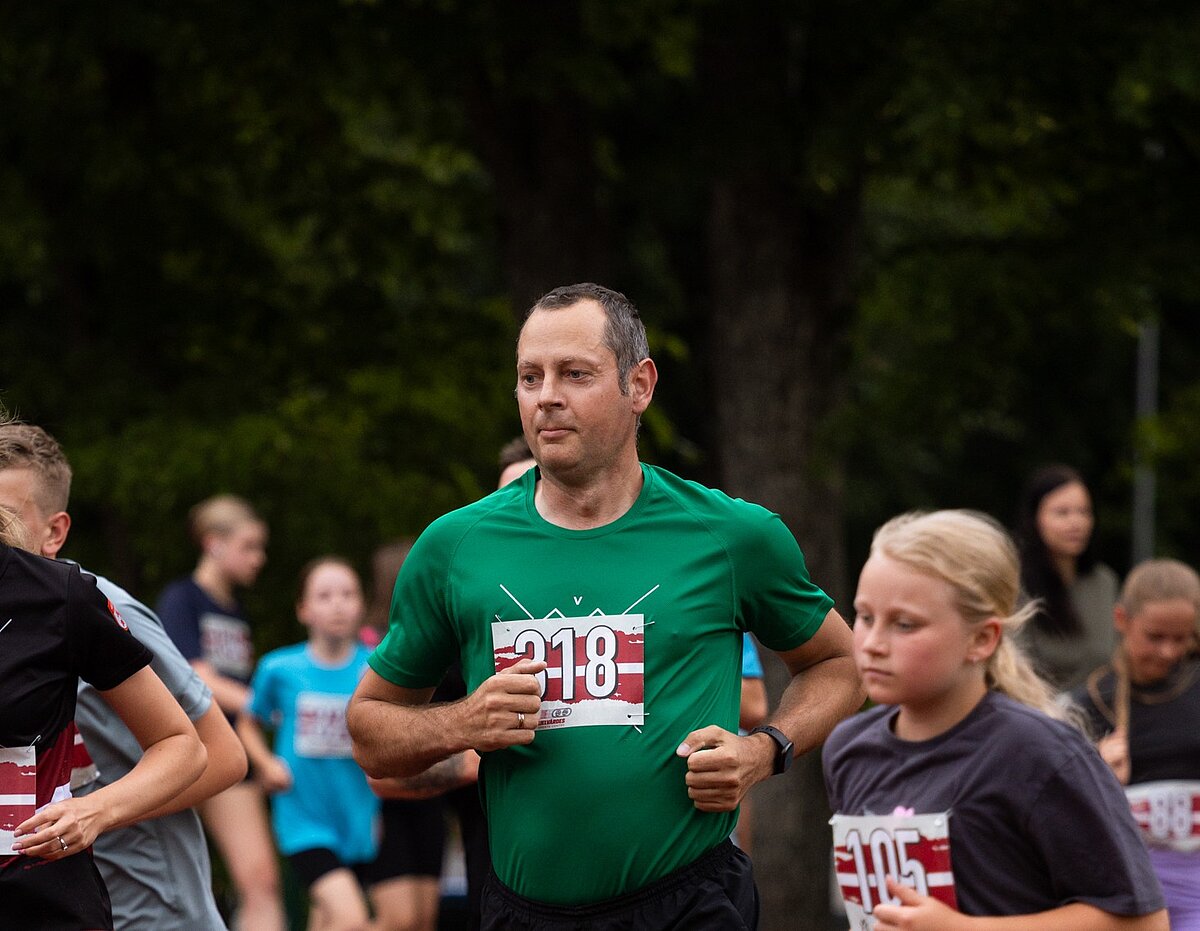
One particularly noteworthy initiative within this group is “Skrējiens pa saulei”. During the two summer months, people gather at the school stadium at a set time every week for a communal run. Many families with children take part, and everyone gets to experience the joy of being active together.
And then there is one activity that is half hobby, half responsibility - developing and improving my household. There is always something that needs doing. I guess I simply like building things - I realise it both when working on projects around the house and when programming.
