
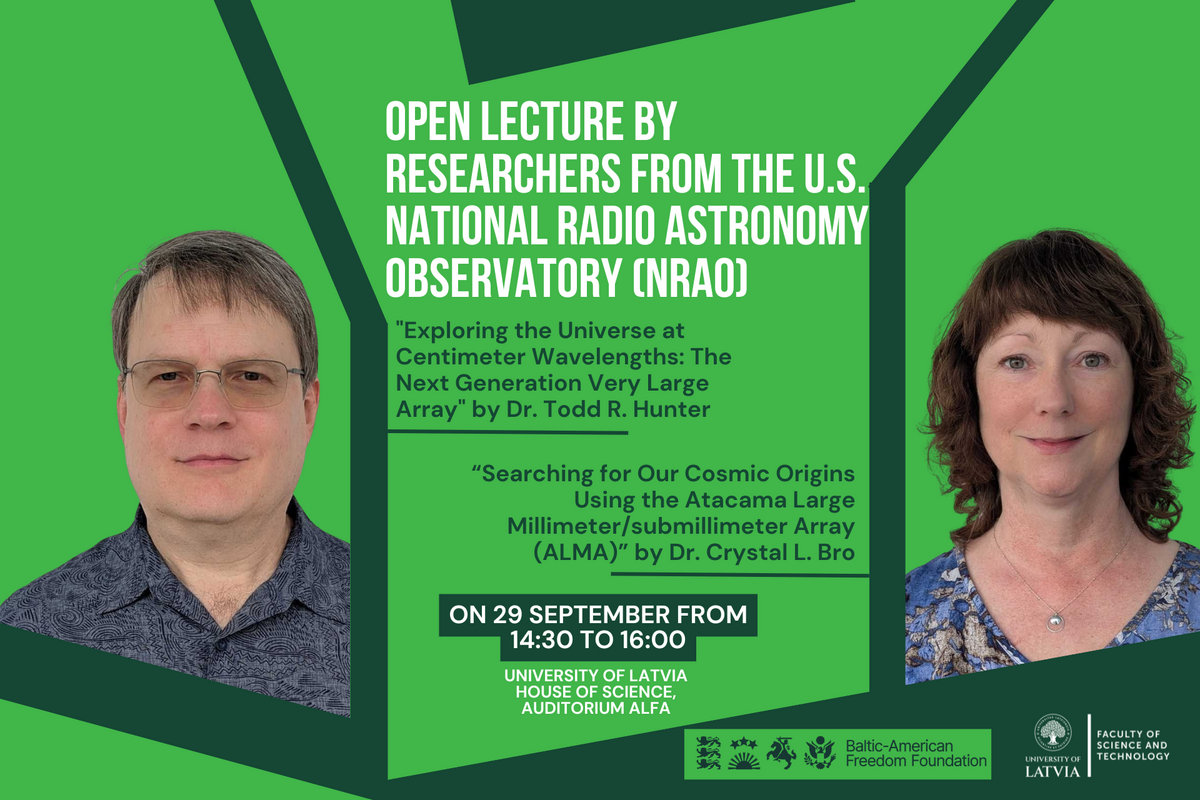
Dr. Todd R. Hunter: “Exploring the Universe at Centimeter Wavelengths: The Next Generation Very Large Array”
Dr. Todd R. Hunter is a senior scientist at NRAO and one of the world’s leading experts in radio astronomy technologies and interferometry. He has more than 25 years of experience in developing state‑of‑the‑art radio astronomy observatories, including significant contributions to the development of ALMA’s data processing and calibration systems.
His research focuses on massive star formation, protostellar outbursts, and the physical processes of the interstellar medium. In his lecture, Dr. Hunter will introduce the next‑generation radio interferometer ngVLA (Next Generation Very Large Array) — a project that will substantially expand humanity’s ability to study the Universe in the centimeter‑wavelength range.
Dr. Crystal L. Brogan: “Searching for Our Cosmic Origins Using the Atacama Large Millimeter/submillimeter Array (ALMA)”
Dr. Crystal L. Brogan is a leading NRAO star‑formation researcher and program scientist, internationally recognized for her contributions to the study of the interstellar medium, cosmic masers, and the birth of new stars. She coordinates ALMA’s scientific and technological development programs and plays an important role in the creation of the next‑generation telescope network ngVLA. With more than 140 peer‑reviewed scientific publications and extensive experience in leading international working groups, Dr. Brogan is one of the most prominent figures in the global radio astronomy community.
In her lecture, Dr. Brogan will explain how the ALMA telescope allows us to peer deep into cosmic clouds where stars and planetary systems are born, and how these observations help us understand our own cosmic origins.
Dr. Artis Aberfelds, lecturer at the UL EZTF Department of Physics, explains: “These are top‑level international experts who drive the development of radio astronomy instruments and can help Latvia advance its communication and data‑processing technologies.”
The lecture is organized with the financial support of the Baltic–American Freedom Foundation (BAFF) and in cooperation with the Ventspils International Radio Astronomy Centre (VSRC) and the University of Latvia (LU) Faculty of Science and Technology (FST).
, Dr. Todd R. Hunter and Dr. Crystal L. Brogan, will take place at the University of Latvia Science House, auditorium Alfa. Everyone interested in learning how modern radio astronomy helps us understand the formation of the Universe is welcome to attend.)